
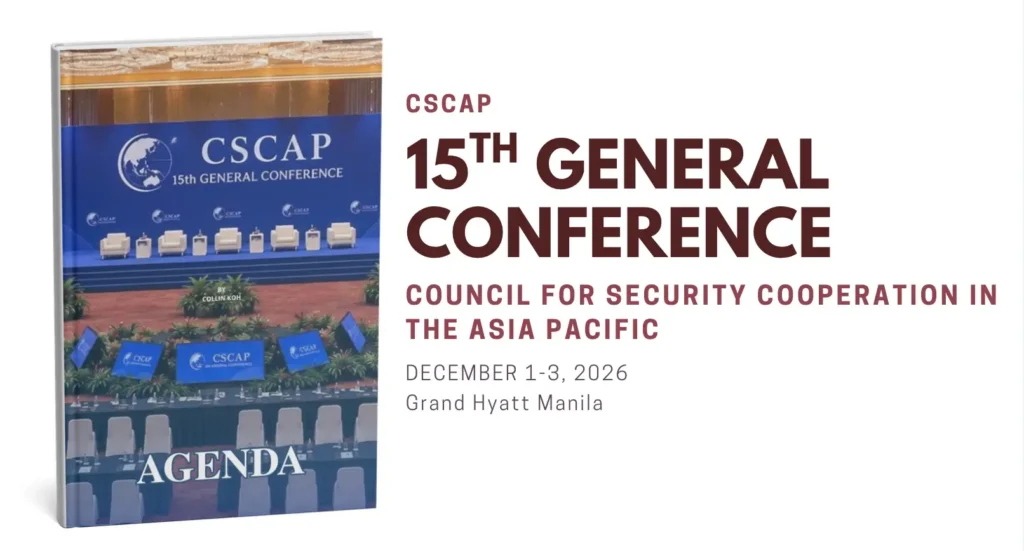
Manila, Philippines — CSCAP Philippines has released the agenda for the 15th Biennial General Conference of the Council for Security Cooperation in the Asia Pacific (CSCAP), marking the first time the Philippines will host the regional security network’s largest gathering since its inaugural conference in Singapore in 1997.
Thank you for reading this post, don't forget to subscribe!Scheduled for 1–3 December 2026 at the Grand Hyatt Manila, the conference will convene leading Track II experts, scholars, and policy practitioners from across the Asia-Pacific under the theme “Regional Security Adrift? Anchoring Order and Stability in the Indo-Pacific.”
The agenda was developed through an extensive consultative process led by Dr. Jeffrey Ordaniel, Co-Chair of CSCAP Philippines, and Lead Convenor of the 15th General Conference. The process incorporated substantive inputs and feedback from CSCAP Member Committees across the Asia-Pacific and Europe, reflecting the differing security concerns and policy priorities of the network’s membership.
The conference is being organized by CSCAP Philippines, with the support of the National Security Council of the Philippines, which co-chairs the Philippine Member Committee alongside the WPS Foundation, and the cooperation of CSCAP Member Committees across the region.
The three-day program will examine issues central to regional peace and stability, including major-power competition, maritime governance and international law, economic security, artificial intelligence and emerging technologies, transnational security threats, nuclear weapons and nonproliferation, and the future of regional security architecture.
Particular attention will be given to the implementation of the United Nations Convention on the Law of the Sea (UNCLOS), including developments in the South China Sea, East China Sea, and Yellow Sea, as well as the implications of economic fragmentation, strategic competition, and emerging technologies for regional stability.
The conference is also expected to address politically sensitive questions that governments may find difficult to discuss openly through formal diplomatic channels. As a Track II mechanism, CSCAP provides a setting in which experts from countries with competing interests and differing strategic perspectives can engage in frank discussions, examine contentious policy questions, and consider possible approaches to managing regional tensions. Likewise, CSCAP also allows for converging interests to result in more impactful and innovative approaches to regional cooperation.
For CSCAP Philippines, hosting the General Conference represents a significant institutional undertaking. Under Ordaniel’s leadership, and with the support of the National Security Council and fellow CSCAP Member Committees, the Manila gathering will seek to translate the network’s mandate into substantive discussions on some of the most difficult questions confronting the Asia-Pacific security order.
The full conference agenda is available for viewing by clicking on the Agenda menu above.